Friday, December 19, 2008

Intellectual Goof ups!


******QOUTABLE QUOTES******

Intel Environment Competition:
Judge : So how do u plan on going about with the implementation of this project?
Roshni: Tsk, That formula is there No! *thinks* kWh x 1000 /100!!
***
Roshni: Dude this pain is really bad. Tylenol isn't enough. I think il take Vallium, its the Deadliest Painkiller Alive!
****
Kat: im so sorry i flicked your plate, but here..iv returned it With Cake!

*****
Chet : Arghh! i dont know what to do with these rubber bands. Take them Madhu.Enjoy!
Madhu: Ooo..can i hurt people ?

********
Madhu:* with a serious expression* Guys, lets all take an auto . Il get down in cunningham road, u carry the auto to college from there.

******
Green Shield Room
chet: listen kritika, u need to do something too for the presentation, it could be anything!
Aishwarya : Oooo! u can be the 'ENTER' person.
******
In Pizza Hut
Chet:Ooo..Lets connect all our straws and drink the juice at the other end of the table!
Meg: Whats wrong with you, you geometrically delusioned spasticated chicken shit.
******
In the BGS hospital canteen
Yogi: *shoves rice into her mouth with a fatass spoon*
Oh, i hate eating with spoons, im more of a hand person
****
(English lecturer) : Girls, all of you must have heard of toad, the insect.
Madhu : Whaa? Toad, an insect? Everyone knows it’s a reptile.
********
Kat : Guys! What do we write on our Green Shield shirts?
Madhu : Ooo… “rediscovering environmental Conversation”

******
Chet: HAPPPYY BIRTHDAYYYY MADHUSHREEE!!!
Madhu: thanks man….but its next month =)
*******
After En Science practical exam
Kulli : See da my dad’s yelling at me for not answering his call. What was I supposed to say? “ Papa, naanu innu thio ilisthayidini”?
*******
Rosh: I haven’t finished En Science assignment dude
Kulli: Eh, don’t take her for granted . She’s already postponated it so many times.
**********
Bus conductor: Pass thorsi ma…
Chet : Sapna. Its ok keep it inside, he’s gone.
Kulli : Eh no da, he hasn’t seen it, I wont close my zip.
*********
Green Shield room Making stuff for our Notice Board. Megs playing recorded version of the Froggie Jemb up from her phone. Suddenly Rosh realizes meg is sitting on something she needed.
Rosh : MEGHNA!!
Nanny: “ Jemmmb Up!”
********

Nanny in deep sleep , 10 in the morning. Woken up by Chet’s phone call.
Chet(Happy & sing song) : GOOD MORNING!!
Nanny(echoing same sing song) : THANK YOU!!
Chet : Aye! I didn’t say happy birthday da
*******

Yahoo Messenger
Chet : Nanny??
Chet : Nanny??
Chet: NANNNNNYYY!!!!
Nanny: Chets, you have a waiting span of a rat scurrying around on a cheese trail.


In Agumbe
Gerry :my baby girl just realised she can rotate her hands
Natasha: Aww, whats her name?
Gerry : Mahelia
Natasha: Where did you get it?
******

Friday, October 31, 2008

So you think you can shoot?


National Geographic International is conducting a photography contest. YES you heard right!
The competition starts on the 1st of December and ends by the 15th Dec 2008. First the applicants send in the photographs to the local National Geographic or http://www.ngphotocontest.com/ (Whoops! today is the last day to submit, pray that your on a time grid far from the East!). Those winners then submit the same to the International National Geographic website.

There are terms and conditions you must follow and are listed in the url link mentioned. http://ngm.nationalgeographic.com/photo-contest/international-rules The grand fiesta prize is a trip to the windy city (where NG's headquater is located), an award ceremony, 50 USD worth of gift and 460$ of spending money.

If it aint your luck this time, there's always next year to look forward too! :)

Wednesday, October 29, 2008

Is there less noise and smoke this time?
Staff Reporter

BANGALORE: Does it seem that this time around Deepavali has been a tad less noisy? With greens fuming over the use of fire crackers — resulting in both environmental and noise pollution — the conscientious Bangalorean may just have moved an inch towards a cleaner and greener way of celebrating the festival of lights.

Concerted efforts by the Bruhat Bangalore Mahanagara Palike (BBMP) through advertisements and repeated appeals to citizens, have ensured that roads have not turned into a complete litter fest. While the traditional few stuck to their annual quota of firecrackers, others decided to take the green turn.

“My seven-year-old daughter came back from school and told me that she has been taught not to burst crackers and pollute the surroundings. There is certainly greater awareness about these things, which may act as a deterrent,” says Venkatachalam, a resident of Vasanthanagar.
Awareness campaigns were held in schools by various non-governmental organisations to educate students on both the environmental aspect and draw their attention to the various hazards faced by child workers in cracker manufacturing industry. Organisations such as Nayak’s Hearing clinic have taken up anti-cracker drives in nearly 350 schools to bring about awareness on the ill-effects of noise pollution.

Shruti Shah, a student of Christ University, says: “I have decided not to burst crackers, so as to do my bit for the environment. Another issue is the fact that these crackers are made by children, which is hazardous to their health.” G. Arumugam, a cracker stall owner at Malleshwaram grounds, says that it has been a lean festival. He has been selling crackers for 15 years and has seen a substantial dent in his revenues this time. “This could be due to a 30 per cent rise in the MRP (maximum retail price) of crackers. Added to this the fact that in spite of paying VAT we are being asked by different government authorities to pay extra dues,” he alleges.

A lull in the market and higher prices of crackers too appear to have influenced the trend this year, says Vatsala Mahalingam, a resident of Indiranagar. Her neighbours, who are into business, used to burst loads of crackers every year. “However, this time around I did not see a single cracker being burst by the members of that family,” she notes.
Source: The Hindu, Bangalore paper. Wednesday, October 29, 2008

Saturday, October 25, 2008

5 things you can reuse or recycle

If you're on a cleaning spree, then you'd come across the issue of disposing things you've tucked away for a very long time. If you're wondering what you should do about it, then here's what a Green Guru would tell you! First, consider if the "junk" can be reused or recycled.


Here are 5 things you can reuse or recycle:


1. The Plastic Problem:
Problem: Plastic, plastic everywhere,

in all the bottles, bags, and tupperware!

Unlike popular beliefs, the number within the triangle at the base, is not a reference to recycling capacity. It is just the composition or chemical make up of plastic.


1) Polyethylene terephalate (PET)
2) High density polyethylene (HDPE)
3) Unplasticised polyvinyl chloride (UPVC) or Plasticised polyvinyl chloride (PPVC)
4) Low density polyethylene LDPE
5) Polypropylene (PP)
6) Polystyrene (PS) or Expandable polystyrene (EPS)
7) Other, including nylon and acrylic

Solution: So, what you can do is simply collect all the plastic (ones which are clean- not moist) and send it to K and K plastics. This plastic waste management use plastic to make a mixture of tar and plastic to make smooth and durable roads. A smooth drive on Miller's road would concur what I just mentioned!

2) The Cloth Clutter:

Problem: Maintaining a wardrobe can be painful, especially if you've kept clothes since the time you were a kid!

Solution: Sending clothes to the charity is a good idea. Not only would you be helping a poorer section of the society, you'd also be saving up on fabric being processed.

Get creative! You could perhaps redesign your shirts and pants, all you need is a little inspiration and a tailor who understands your concept. Fabric can be used to make cloth bags as well! (Think about it, you could be a fashion guru at your college campus! wink wink)

3) The Gadget Garbage:

Problem: Old CPUs, television and computer spare parts, emergency lamps, batteries contain heavy metals including mercury, zinc, lead, cadmium etc which when oxidised, effects the nervous system on acute exposure and on chronic exposure causes kidney and liver disorders.


Most wastes are either burnt or dumped in a landfill or at a waterbody. So finding high levels of heavy metals in the ground water tables are compounded at wastes dumps.

Solution: e-waste or electronic-waste can be given to a specialised group of people who involve in reusing the metals from e-wastes. The Indo-German-Swiss based group called e-waste have their headquaters in namma Bengaluru. A simple phone call and all your e-waste will be picked up from your residence or company. Browse through http://www.e-waste.in/ to get in touch with the people from your city.

4. The Paper Pile:

Problem: If you are a student this resource will be abundant in your room! Notebooks, newspapers, magazines, envelopes, old phone book are other sources of paper wastes.

Solution: Hunt down that paperwalla or recycle your own paper! the video in this url link can show you how. (www.metacafe.com/watch/820961/how_to_recycle_paper_homemade_letter_paper )

This is perhaps a good idea if you would like a personally made recycled-paper book. I can't vouch that the paper you make in the first batch can be used, but if you've got skill and patience, you'd eventually learn the trick of the trade.

Solution for impatient people: unused pages from old notebooks can be torn, collected and re-bound. :)

5. The Faulty Furniture:

Problem: As you would imagine most furniture like in the 1970's are made out of wood. The resource is not a renewable one, unless the industries take care to replenish the barren land with fresh tree saplings. How often is that? NOT that often!


If you are finding it difficult maintaining or finding space or you are tired of looking at your old furniture at your crib, there's only one practical solution to it.

Solution: EXCHANGE it for better furniture! Call an old furniture dealer or even your local carpenter! Not only are you being economical but environmentally friendly as well as the wood used could be broken down to make other furniture or some wood craft.

Wednesday, October 22, 2008

Picture Perfect

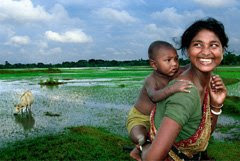
Recently Chartered Institute of Water and Environmental Management (CIWEM), London searched for an Environmental Photographer of the Year 2008. This year, Abhijit Nandi’s winning picture "Happy in Her Own World", which also won the Quality of Life Category made a mark in the exhibition.


The 2008 Environmental Photographer of the Year exhibition includes images that are resonant, creative and beautiful.


Over 1,400 pictures were entered into the competition, examining issues such as poverty, climate change, human rights, leisure, culture, biodiversity and natural beauty. The categories were Changing Climates; Black & Veatch's World of Difference; Quality of Life; The Natural World; and a special Under 21 category which had no thematic boundaries.


The entries were judged on impact, creativity, composition, originality and technical abilities, by some of the most respected environmental photographers in the industry, including Gary Braasch, winner of the Ansel Adams Award for Conservation Photography, Anthony Epes and Ronnie Israel. Chris Smith, Chairman of the Environment Agency selected the final overall winner who became the Environmental Photographer of the Year.


Photographs were displayed from 17th September until 10th October 2008 at The Art Pavilion, Mile End Park, east London.

Source: http://www.ciwem.org/arts/photographer/

Thursday, October 2, 2008

"The Armchair Environmentalist!"

I'm an environmentalist, but I like my comforts. Air conditioning I just can't do without.. because of global warming and pollution (like duh!) when I'm driving around in my car. I lecture people about alternate sources of energy and the depletion of fossil fuels, but my ride runs on petrol (unleaded of course!) and gives me 13km a litre!!! :)
But i do my best.. I switch off my engine when I'm in a jam, pick up friends if they're on my way...
Even at home, I AM the reason why the lights are CFLs and the refrigerator doesn't emit CFCs. But somethings are necessary: I MUST have a hot water bath, because well, I'd definitely become an icicle if I didn't!! But the other appliances are more eco-friendly (joy!!) the air conditioner has a power-saving mode, the fan must be on all the time (because i can't go to sleep without that soothing whirring noise), but at least it has a regulator, and it's not always on full speed!
Being an environmentalist is tough, it needs you to make a lot of compromises: my appliances are now on stand-by instead of being on when I'm not using them, and I turn them off when I'm going out! But don't ask me where the old appliances I throw away go when I'm through with them, because.. well, the new one works great!
The food and drinks I buy also bring me credit- all the water and juice bottles i buy are recyclable, and I throw all my litter into dustbins! No doubt the city corporation will do its bit from there, and it will no longer be my sin! :)
As far as possible, I buy organic produce and imported canned food (because their eco-standards are much higher than ours, obviously, and so the food will be too!) 
When I'm eating out at my favourite KFC or McDonald's, I prefer not to take a carry-away, and so eliminate the need to take with me the plastic wrapping they so faithfully wrap my food in! Also, dining there means that their delivery boys don't have to waste precious fossil fuel in coming home to deliver my meal. It doesn't really matter to me how far their ingredients had to travel before they reached my plate- they can import my meat and fillings, its cool with me. Besides, coke is healthier than fresh fruit juice because it doesn't put undue stress on our country's farmers, don't you think?! And so what if they're depleting the ground water resources of some unheard-of village to set up the plants, and so that they can run their high-tech machines and sterilize my bottles properly? 
And so what if their food is all genetically modified?? Those veges actually look like healthy ones.. they haven't got any bugs in them, and besides, G.M. is technology that uses nature to make stuff more useful for us. Nature twisted to our benefit- could I ask for more? After all, we are CO-EXISTING! :)
But sometimes it bothers me, because mutated plants override well developed ancient DNA characteristics, and eventually eliminate any kind of natural biodiversity that ever existed. At the end of the day, I am an environmentalist, so all of this troubles me. But not enough.
Ultimately, there are things that I would do, and then there are things I just can't afford to do, given my lavish lifestyle. I'm not going to start smelling ugly because my deodorant is harmful to the ozone layer. I'm not going to wash all my dirty plastics to reuse them, because it's a dreadful waste of time. I'm not going to give up my routine chai and cigarette when I'm on breaks from work- maybe I'm an addict.. but I can't help it. I'm not going to stop running my washing machine everyday. I'm not going to stop eating at Baskin Robins, McDonald's, or SubWay. And I'm definitely not going to stop eating Kellogg's or drinking coke, Pepsi, sprite and Red Bull--absolutely not!!
BUT I TELL YOU, I'M AN ENVIRONMENTALIST.. 
just a PATHETIC EXCUSE OF AN ENVIRONMENTALIST.
an ARMCHAIR ENVIRONMENTALIST?!!!

Monday, September 29, 2008

Our Real Problem...


“Nature doesn’t have a design problem. People do.”
(Quote from William McDonough and Michael Braungart)

You don’t need to be studying environmental science to have heard about global warming, pollution, or the fuel crisis. The environment is everything around us and its protection is something we hear about everyday. I have grown up conscious of saving electricity by switching off the lights and fans when I leave a room, reducing the amount of water I use, and recycling paper and plastic. Towards the end of high school however I had begun to wonder whether following the principle of “Reduce-Reuse-Recycle” was enough.

Recognising that environmental hazards are a pressing concern, most of us have the knee-jerk reaction of trying to curtail, or suppress the activities that lead to environmental damage. This approach at best only reduces pollution. While we are slowing down environmental degradation, we aren’t stopping it or repairing the damage already done. We are simply postponing the day we’ll have to deal with the real problem.

Given that the majority of environmental damage is caused by industrial activities, I believe the real problem is that environmentalists and industrialists are always in conflict. Environmentalists believe that industrialisation and economic development will only further deteriorate our already fragile environment. On the other hand, curbing industrialisation in an attempt to protect the environment is detrimental to economic growth! GreenFuel’s Emissions-to-Biofuels™ process brilliantly contradicts this typical viewpoint.

GreenFuel is a privately held, venture-backed firm that was started in 2001. They use sophisticated technology to profitably recycle CO2 from factory emissions by using photosynthetic algae. The process is fairly simple:
Factory emissions rich in Greenhouse Gases such as Carbon Dioxide and Nitrous Oxides, are fed through a “photo-bioreactor”. The process harnesses photosynthesis to grow algae in suspension, which captures the CO2 passed through the bioreactor. The algal cells obtain Nitrogen for nutrition from the Nitrous Oxides in the flue gas. In this way, huge amounts of CO2 and NOx are removed from exhaust before clean flue gases enter the atmosphere.

The bioreactor is designed to be retrofitted to flue stacks of fossil-fired power plants and other anthropogenic sources of carbon dioxide with minimal impact to ongoing operations.

Using commercially available technology, the algae can then be economically converted to solid bio-mass fuel, methane or liquid transportation fuels such as biodiesel and ethanol.

It is the production of this biodiesel as by-product that makes this technology so brilliant. Biodiesel can itself be used as a source of energy. On burning, it produces more CO2, but only the amount it used in forming itself. This very CO2 fuels and restarts photosynthesis if passed through the bioreactor again. As a result, it is possible to get three or four times the energy for the same amount of CO2. The circular nature of this process makes it virtually self sufficient and highly efficient. Consequently, the waste of the power production process becomes valuable input for the production of biodiesel, all while removing a large majority of Greenhouse gases from in-place factory machinery!

The biofuel produced is also a source of extra profit. This allows a factory to recycle its CO2 emissions efficiently, and make money as that happens.

We live in a world that has become very environmentally sensitive. Being environmentally friendly in technology and policy is not only necessary, it has also become acknowledged as sensible to be so. This acknowledgement is manifested in proactive stances such as signing of the Kyoto Protocol internationally, and setting up of a functional ‘Ministry of Environment’ whose clearance is needed before any new industry is set up.

However, while we recognise the need for environmental protection, it is not motivation enough to make huge lifestyle changes. The fact that the GreenFuel process is financially viable in addition to being environmentally friendly, makes it that much more attractive.

I stumbled upon the patented GreenFuel process while working – with my 3 teammates – on our submission for The Global Challenge Award, 2007. Our project was to propose a possible solution to Global Warming and to develop a functional business plan to sell this solution in three countries. Developing a business plan involved in-depth market and industry analyses in each country, along with a study of political and financial feasibilities of the process, specific to each country.

My team’s project presented the GreenFuel technology and bioreactor as what we thought was today’s best solution to Global Warming. We thought that the way the technology worked was brilliant – so simply, efficiently, self-sufficiently and innovatively. We proposed a business plan that aimed at selling the bioreactor and its technology to thermal power plants in India, the United States, and China – three of the world’s biggest contributors to Greenhouse gas emissions.

Power plants typically have the required space for the bioreactor to be set up, and also are capable of putting in the large initial investment necessary to start the process. Financially, we found that investments would be made up in a matter of three years. This is why we thought it best to initially propose this technology to power plants before expanding to other sources of Greenhouse gas emission. Politically, all three countries are under Kyoto Protocol and are very committed to being environmentally friendly.

While developing the business plan, my teammates and I read a book called “Cradle to Cradle – Remaking the Way We Make Things” by William McDonough and Michael Braungart. This book suggests that the problem is not that our machinery pollutes too much…it is that it pollutes at all. The authors of the book say that the key to sustainable development is in innovation of design.

Human beings have always been about innovation. At the beginning, necessity was the mother of invention. We would invent and innovate to fulfil a need. Once a need is fulfilled, technology can be improved on, to make it more efficient, cheaper, or more sophisticated. What we need is to add ‘environmental concerns’ to the list of factors that call for innovation of design.

It is impossible and unrealistic to expect massive changes in lifestyle or short term sacrifices from individuals or industry for long term goals of environmental protection for the so-called greater good of the future. While it is difficult to change the opinions of each member of society one-by-one by talking about environmental protection, money is something everyone relates to. I strongly believe that the solution to environmental problems lies in creating new design; for technology as well as for management principles; that works with the system instead of against it; technology that can be simple, efficient and profitable while being environmentally friendly.

It has become my passion to spread awareness about this new management and production philosophy; by mentoring other students through The Global Challenge Award process, through my own projects and presentations, and through other activities I take part in.

To take just one example, I have recently joined a Plastic Waste Management Project through my college. A company in Bangalore, called K.K Plastics collects plastic waste and converts the waste to power. This powder is being used to lay roads in five cities in India. This process utilises wastes that would otherwise be clogging up our drains, contaminating our water and soil, or poisoning our wildlife. One cannot deny the huge number of people involved in the production and use of plastic. We would be endangering the livelihood of these people as well as the development of any industry that utilises plastic, by banning its use. K.K Plastics, on the other hand, is utilising this non-biodegradable pollutant to address the crying need for better roads in India. This approach to plastic waste management is so much better than expecting people to stop using plastic all together.

Here too, the brilliance of the process lies in its innovation.
I believe that more people need to promote this kind of philosophy; that redesigning technology and policies is the key to sustainable development and a cleaner tomorrow. Particularly so, students of Environmental Science, Engineering and Management. Environmental concerns needs to be a factor of production and design, not a deterrent to economic activity. We, like GreenFuel and K.K Plastics, need to find ways to work with environmentalists AND industrialists, perhaps taking our cue from nature. After all, like the authors of Cradle to Cradle say… “Nature doesn’t have a design problem. People do.”


Powered By Blogger