Wednesday, October 22, 2008

Picture Perfect

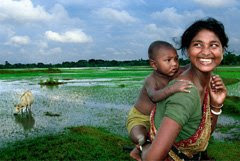
Recently Chartered Institute of Water and Environmental Management (CIWEM), London searched for an Environmental Photographer of the Year 2008. This year, Abhijit Nandi’s winning picture "Happy in Her Own World", which also won the Quality of Life Category made a mark in the exhibition.


The 2008 Environmental Photographer of the Year exhibition includes images that are resonant, creative and beautiful.


Over 1,400 pictures were entered into the competition, examining issues such as poverty, climate change, human rights, leisure, culture, biodiversity and natural beauty. The categories were Changing Climates; Black & Veatch's World of Difference; Quality of Life; The Natural World; and a special Under 21 category which had no thematic boundaries.


The entries were judged on impact, creativity, composition, originality and technical abilities, by some of the most respected environmental photographers in the industry, including Gary Braasch, winner of the Ansel Adams Award for Conservation Photography, Anthony Epes and Ronnie Israel. Chris Smith, Chairman of the Environment Agency selected the final overall winner who became the Environmental Photographer of the Year.


Photographs were displayed from 17th September until 10th October 2008 at The Art Pavilion, Mile End Park, east London.

Source: http://www.ciwem.org/arts/photographer/

Thursday, October 2, 2008

"The Armchair Environmentalist!"

I'm an environmentalist, but I like my comforts. Air conditioning I just can't do without.. because of global warming and pollution (like duh!) when I'm driving around in my car. I lecture people about alternate sources of energy and the depletion of fossil fuels, but my ride runs on petrol (unleaded of course!) and gives me 13km a litre!!! :)
But i do my best.. I switch off my engine when I'm in a jam, pick up friends if they're on my way...
Even at home, I AM the reason why the lights are CFLs and the refrigerator doesn't emit CFCs. But somethings are necessary: I MUST have a hot water bath, because well, I'd definitely become an icicle if I didn't!! But the other appliances are more eco-friendly (joy!!) the air conditioner has a power-saving mode, the fan must be on all the time (because i can't go to sleep without that soothing whirring noise), but at least it has a regulator, and it's not always on full speed!
Being an environmentalist is tough, it needs you to make a lot of compromises: my appliances are now on stand-by instead of being on when I'm not using them, and I turn them off when I'm going out! But don't ask me where the old appliances I throw away go when I'm through with them, because.. well, the new one works great!
The food and drinks I buy also bring me credit- all the water and juice bottles i buy are recyclable, and I throw all my litter into dustbins! No doubt the city corporation will do its bit from there, and it will no longer be my sin! :)
As far as possible, I buy organic produce and imported canned food (because their eco-standards are much higher than ours, obviously, and so the food will be too!) 
When I'm eating out at my favourite KFC or McDonald's, I prefer not to take a carry-away, and so eliminate the need to take with me the plastic wrapping they so faithfully wrap my food in! Also, dining there means that their delivery boys don't have to waste precious fossil fuel in coming home to deliver my meal. It doesn't really matter to me how far their ingredients had to travel before they reached my plate- they can import my meat and fillings, its cool with me. Besides, coke is healthier than fresh fruit juice because it doesn't put undue stress on our country's farmers, don't you think?! And so what if they're depleting the ground water resources of some unheard-of village to set up the plants, and so that they can run their high-tech machines and sterilize my bottles properly? 
And so what if their food is all genetically modified?? Those veges actually look like healthy ones.. they haven't got any bugs in them, and besides, G.M. is technology that uses nature to make stuff more useful for us. Nature twisted to our benefit- could I ask for more? After all, we are CO-EXISTING! :)
But sometimes it bothers me, because mutated plants override well developed ancient DNA characteristics, and eventually eliminate any kind of natural biodiversity that ever existed. At the end of the day, I am an environmentalist, so all of this troubles me. But not enough.
Ultimately, there are things that I would do, and then there are things I just can't afford to do, given my lavish lifestyle. I'm not going to start smelling ugly because my deodorant is harmful to the ozone layer. I'm not going to wash all my dirty plastics to reuse them, because it's a dreadful waste of time. I'm not going to give up my routine chai and cigarette when I'm on breaks from work- maybe I'm an addict.. but I can't help it. I'm not going to stop running my washing machine everyday. I'm not going to stop eating at Baskin Robins, McDonald's, or SubWay. And I'm definitely not going to stop eating Kellogg's or drinking coke, Pepsi, sprite and Red Bull--absolutely not!!
BUT I TELL YOU, I'M AN ENVIRONMENTALIST.. 
just a PATHETIC EXCUSE OF AN ENVIRONMENTALIST.
an ARMCHAIR ENVIRONMENTALIST?!!!

Monday, September 29, 2008

Our Real Problem...


“Nature doesn’t have a design problem. People do.”
(Quote from William McDonough and Michael Braungart)

You don’t need to be studying environmental science to have heard about global warming, pollution, or the fuel crisis. The environment is everything around us and its protection is something we hear about everyday. I have grown up conscious of saving electricity by switching off the lights and fans when I leave a room, reducing the amount of water I use, and recycling paper and plastic. Towards the end of high school however I had begun to wonder whether following the principle of “Reduce-Reuse-Recycle” was enough.

Recognising that environmental hazards are a pressing concern, most of us have the knee-jerk reaction of trying to curtail, or suppress the activities that lead to environmental damage. This approach at best only reduces pollution. While we are slowing down environmental degradation, we aren’t stopping it or repairing the damage already done. We are simply postponing the day we’ll have to deal with the real problem.

Given that the majority of environmental damage is caused by industrial activities, I believe the real problem is that environmentalists and industrialists are always in conflict. Environmentalists believe that industrialisation and economic development will only further deteriorate our already fragile environment. On the other hand, curbing industrialisation in an attempt to protect the environment is detrimental to economic growth! GreenFuel’s Emissions-to-Biofuels™ process brilliantly contradicts this typical viewpoint.

GreenFuel is a privately held, venture-backed firm that was started in 2001. They use sophisticated technology to profitably recycle CO2 from factory emissions by using photosynthetic algae. The process is fairly simple:
Factory emissions rich in Greenhouse Gases such as Carbon Dioxide and Nitrous Oxides, are fed through a “photo-bioreactor”. The process harnesses photosynthesis to grow algae in suspension, which captures the CO2 passed through the bioreactor. The algal cells obtain Nitrogen for nutrition from the Nitrous Oxides in the flue gas. In this way, huge amounts of CO2 and NOx are removed from exhaust before clean flue gases enter the atmosphere.

The bioreactor is designed to be retrofitted to flue stacks of fossil-fired power plants and other anthropogenic sources of carbon dioxide with minimal impact to ongoing operations.

Using commercially available technology, the algae can then be economically converted to solid bio-mass fuel, methane or liquid transportation fuels such as biodiesel and ethanol.

It is the production of this biodiesel as by-product that makes this technology so brilliant. Biodiesel can itself be used as a source of energy. On burning, it produces more CO2, but only the amount it used in forming itself. This very CO2 fuels and restarts photosynthesis if passed through the bioreactor again. As a result, it is possible to get three or four times the energy for the same amount of CO2. The circular nature of this process makes it virtually self sufficient and highly efficient. Consequently, the waste of the power production process becomes valuable input for the production of biodiesel, all while removing a large majority of Greenhouse gases from in-place factory machinery!

The biofuel produced is also a source of extra profit. This allows a factory to recycle its CO2 emissions efficiently, and make money as that happens.

We live in a world that has become very environmentally sensitive. Being environmentally friendly in technology and policy is not only necessary, it has also become acknowledged as sensible to be so. This acknowledgement is manifested in proactive stances such as signing of the Kyoto Protocol internationally, and setting up of a functional ‘Ministry of Environment’ whose clearance is needed before any new industry is set up.

However, while we recognise the need for environmental protection, it is not motivation enough to make huge lifestyle changes. The fact that the GreenFuel process is financially viable in addition to being environmentally friendly, makes it that much more attractive.

I stumbled upon the patented GreenFuel process while working – with my 3 teammates – on our submission for The Global Challenge Award, 2007. Our project was to propose a possible solution to Global Warming and to develop a functional business plan to sell this solution in three countries. Developing a business plan involved in-depth market and industry analyses in each country, along with a study of political and financial feasibilities of the process, specific to each country.

My team’s project presented the GreenFuel technology and bioreactor as what we thought was today’s best solution to Global Warming. We thought that the way the technology worked was brilliant – so simply, efficiently, self-sufficiently and innovatively. We proposed a business plan that aimed at selling the bioreactor and its technology to thermal power plants in India, the United States, and China – three of the world’s biggest contributors to Greenhouse gas emissions.

Power plants typically have the required space for the bioreactor to be set up, and also are capable of putting in the large initial investment necessary to start the process. Financially, we found that investments would be made up in a matter of three years. This is why we thought it best to initially propose this technology to power plants before expanding to other sources of Greenhouse gas emission. Politically, all three countries are under Kyoto Protocol and are very committed to being environmentally friendly.

While developing the business plan, my teammates and I read a book called “Cradle to Cradle – Remaking the Way We Make Things” by William McDonough and Michael Braungart. This book suggests that the problem is not that our machinery pollutes too much…it is that it pollutes at all. The authors of the book say that the key to sustainable development is in innovation of design.

Human beings have always been about innovation. At the beginning, necessity was the mother of invention. We would invent and innovate to fulfil a need. Once a need is fulfilled, technology can be improved on, to make it more efficient, cheaper, or more sophisticated. What we need is to add ‘environmental concerns’ to the list of factors that call for innovation of design.

It is impossible and unrealistic to expect massive changes in lifestyle or short term sacrifices from individuals or industry for long term goals of environmental protection for the so-called greater good of the future. While it is difficult to change the opinions of each member of society one-by-one by talking about environmental protection, money is something everyone relates to. I strongly believe that the solution to environmental problems lies in creating new design; for technology as well as for management principles; that works with the system instead of against it; technology that can be simple, efficient and profitable while being environmentally friendly.

It has become my passion to spread awareness about this new management and production philosophy; by mentoring other students through The Global Challenge Award process, through my own projects and presentations, and through other activities I take part in.

To take just one example, I have recently joined a Plastic Waste Management Project through my college. A company in Bangalore, called K.K Plastics collects plastic waste and converts the waste to power. This powder is being used to lay roads in five cities in India. This process utilises wastes that would otherwise be clogging up our drains, contaminating our water and soil, or poisoning our wildlife. One cannot deny the huge number of people involved in the production and use of plastic. We would be endangering the livelihood of these people as well as the development of any industry that utilises plastic, by banning its use. K.K Plastics, on the other hand, is utilising this non-biodegradable pollutant to address the crying need for better roads in India. This approach to plastic waste management is so much better than expecting people to stop using plastic all together.

Here too, the brilliance of the process lies in its innovation.
I believe that more people need to promote this kind of philosophy; that redesigning technology and policies is the key to sustainable development and a cleaner tomorrow. Particularly so, students of Environmental Science, Engineering and Management. Environmental concerns needs to be a factor of production and design, not a deterrent to economic activity. We, like GreenFuel and K.K Plastics, need to find ways to work with environmentalists AND industrialists, perhaps taking our cue from nature. After all, like the authors of Cradle to Cradle say… “Nature doesn’t have a design problem. People do.”


The future is in our hands


The year is 2008. The millennium year went by nearly eight years ago. It was then, when prophecies about an apocalypse were forewarned by the likes of Notra Damus and the reverent Gurus from the Himalayas. Few religiously believed it would occur, while others laughed it off.

In the recent past, newspapers and TV news channels have been reporting life-threatening hurricanes and tsunamis, catastrophic wildfires, droughts and seismic repercussions all around the world. But man stood powerless, witnessing the mayhem around him.

What went wrong?

Before the time of Industrialisation, our predecessors were curious and questioned everything they saw and discovered. They ventured to every corner of the world in search of their answers. They looked up to the sky and tapped and every rock and pebble; Somewhere long they discovered fuel, minerals, metals, chemicals which could be altered and lots more. Eventually, we’ve “progressed” by using these products lavishly, making a luxurious possession, a basic necessity. The sources were, after all, more than just abundant!

What have we come to?

Come World War I and World War II, and man held the world in his palm. He decided what to do with the lives of people, animals and plants. He owned weapons, killed animals for hide, felled acres of trees to process furniture, paper and wood as fuel. Added to that list, he took the lives of his fellow beings; the Hiroshima-Nagasaki atomic bomb explosion for example, had annihilated most parts of that area and mutated those who were spared.

For several years, many countries rattled the Earth while waging wars. They left a colossal amount of damage to the economy and the environment.

Many countries managed to redeem their power in the economic arena, by enterprising industrial scaled projects and called themselves ‘developed countries’ while others ‘developing countries’ stood not far away. The increasing number of industries rose proportionately with product demand.

Industries laboriously worked in meeting the demand. Green lands turned grey as plant resources were uprooted, chimneys smoked thick soot and large amounts of untreated effluents were discharged into nearby water bodies. The quality of the environment deteriorated. Air became unbearable to breathe, the soil infertile and the water contaminated.

Birds and fish among all animals were chocked to death and were the first to be affected by pollutants. Animals lost their homes to anthropocentric activities and disappeared from the face of Earth. The world started to suffer a slow death.

What can we do?

Until recent times, the Earth beckoned for our help and we stayed oblivious to it. Most environmental hazards including hurricane, tsunami, temperature rise, ice melt down are due to direct or indirect cause of global warming.

Since we are responsible for the volatile change in the environment- specifically the ozone hole and climate change, it is our responsibility to set things right. It’s important to be a part of the solution, not the problem.

Awareness is half the cure. Al Gore, the former vice president of America used his power by spreading word about climate change through his award-winning documentary ‘The Inconvenient truth.’ His work has sent waves across the world, driving people to work towards a clean environment.

Keeping this perspective in mind, as a student of Environmental Science, I had the privilege to start a student-based organisation at college called ‘Green Shield.’ We work with NGOs and spread word about the environment among students.

In the past three months, we had a ‘No Plastic movement’ where we spoke to schools and few colleges. We invited a self support group called ‘the Belaku Trust’ that made recycled paper and cloth products, to sell at our college. As a part of our credit programme, we have tied up with a company called ‘KK plastics’. This company aims at using plastic to tar the roads. Not only are the roads durable, we seem to have found a solution to plastic wastes.

From college, we had visited the largest lake in Bangalore called the ‘Bellandur Lake’ and its’ village as a part of our community development programme. I had the opportunity to participate in a Lead analysis campaign, where we have tested positive for lead in the lake as well as in some ground water samples.

As a part of our climate change awareness program we assembled people to join the NGO, ‘Treesforfree’ in an afforestation movement called ‘Plantaton’.

Green Shield has moulded me in an adverse way and was a channel to prove my leadership qualities- responsibility, reliability and to motivate as well as bind my team, barring their differences, to ultimately harness their strongest skills. During tense situations, I had the capability to maintain my poise and socially, I was able to mingle with ease among the distinguished and the infamous of all ages alike.

As a student of environmental science, I am convinced that there is a critical need to not only to bring awareness to the public about the environmental issues, but to be able to bridge the gap between the long-thought rivals, the industrialists and the environmentalist. I believe that at a national and an international level, we can develop and grow economically as well as environmentally using clean technology, for a better tomorrow. As our Green Shield motto says, we should be “Guarding today, for tomorrow.”

Blue-less Earth


“Mom”, she called out from her room, “bring the mineral oil, quickly! I am getting late for school”. Tanya’s mother comes into the room with a small bottle and a piece of cloth. She then dabs the cloth with the oil and wipes her daughter’s hands, legs, face and baldhead.

According to our country’s former President Dr APJ Abdul Kalam, what has been described above is almost certainly going to be a daily ritual practiced by most people in their homes, say, fifty years from now. What else could one resort to, in the absence of our life sustaining resource…water?
This is how we kick started our first Environmental Science lecture in college - by coming to terms with the predictions made by one of our country’s best scientists. What it did, more than anything else, was to bring everything into perspective, show us exactly where we stand in time and how far we have come, in both a positive and negative light. It is indeed alarming and absurd to think of humankind reaching such dire circumstances where going bald and switching to mineral oil will be the only means of staying clean and hygienic. So, fifty years from now would mean that whatever Dr. Kalam claims might happen, and IS probably going to happen, if not in our lifetime, then definitely well within that of our children.

General statistics say that water covers 71% of the earth’s surface. To those who do not feel the need to study further into matters such as the subsequent division of that water, 71% seems like more than just sufficient. What they don’t realize is that of the 71%, up to 97% of the water is saline rendering it virtually unusable by man. The remaining is fresh water. Again, part of that water is locked in the ice caps, glaciers and hot springs, together constituting about 2.4%.

That leaves us, a population of almost 6.5 billion, dependent on just 0.6% of consumable water. This 0.6% is being used for varied purposes ranging from agriculture and hydroelectric power generation to cooking, drinking and bathing, by people all over the world.

In countries like the United Kingdom, the average person uses more than 50 litres of water a day flushing toilets. The highest average water use in the world is in the US, at 600 liters day. Statistics will also tell you that 85 per cent of urban India has access to safe, piped drinking water. However, statistics lie. Every person in cities today get by with about 71 litres per day, less than six flushes of an average toilet.
At this rate providing 145 litres of piped, treated water per day to the rest of urban India in the next three years will require an astronomical investment of about Rs 34,000 crore. Already states like Tamil Nadu and Andhra Pradesh are suffering due to shortage in the piped-water supply in many of its cities and towns.

It is indeed overwhelming to think of how pressed for resources we really are, and it is only going to get worse if we don’t wake up and take action soon.

The presence of water, like air, is always taken for granted, on the assumption that it will last forever. And Man is such that he is likely to do nothing about it until the very last moment, when he realizes that he is late for a meeting with an important client and has no water to wash the soap off his face. And once it is too late he will wake up, protest and demand answers as to why the government did not look into the matter sooner why nobody warned him. Each one begins to blame the person sitting next to him and starts trying to find excuses in defense. When all along, all he had to do was think wisely and use sensibly. With respect to our present day water crisis alone there are many choices that can be made to rectify our shortcomings.

Trapping rainwater and reusing it instead of letting it evaporate from our roads and terraces alone can solve some of our problems. Using buckets instead of hosepipes and showers on a day-to-day basis will also cut down the rate of consumption. This way more can be benefited. However, practically it will be of little use if only one person or one group of people puts these ideas into practice. This is where spreading of awareness comes into the picture.

The whole concept of sustenance needs to be taught or rather inculcated in the people right from childhood - ‘catch them young’ as they say. They need to learn to use and at the same time preserve for the generations after them. Many people take pride in knowing what the present situation on our planet is, in terms of how we are impacting the earth & nature. However just knowing isn’t enough, you need to take the next step and become accountable for what you do.

Dr Kalam had also said that if we continue to waste our water resources the way we presently are, by the year 2070, we would most likely be killing one another for a mere bottle of drinking water. Desalinating water will probably be one of the only jobs available. Children will start dying of mere desiccation of skin. All in all, life will become unimaginable.

Do we want that? Do we want our children to be born into a world where wanting to quench one’s thirst is like wishing that money grew on trees, something simply out of the question! No, we don’t. No one does. Hence, we must act before what we are left with is a lifeless, blue-less earth.
Monday, September 1, 2008

Dreams On An 18,000 Rupee Cheque


Maybe it was the weather; the fact that it was a little cloudy… dark clouds teased us with the threat of rain. Maybe the looming end of yet ANOTHER semester makes one muse about the future. Then again, maybe it wasn’t half as romantic as that, and we started talking about our dreams and plans for the future simply because Aruna’s zoology class is downright boring.

My mind was wandering already, the way it usually does – jumping quickly from one random thought to another, when I got a note from Chetana, who sat behind me. The note seemed to be in an old check from ICICI of Roshni’s - undoubtedly one she had forgotten to cash…or one she simply could not use thanks to some circumstance only Roshni could get stuck in.

“So what up yo! Ok…imagine yourself when you are 25. Where do you see yourself? Give a description right down to what you’re wearing, and what’s on your mind. =) ”!

My first instinct was to laugh. Only Chet could come up with that in the middle of a class on vertebrate respiration and really expect and answer. In turned to pass her a bemused smile, and got a toothy grin in response. “Alright…” I thought. “Where do I see myself in 6 years…?”

Ever tried answering that question? Answering it is crazy hard! Every response created a Polaroid image…a single snapshot – speaking a thousand words on what we want our futures to look like. I was amazed at the ambition and diversity I found in one section of one class… Environmental lawyers and managers, science communicators, films in the making, wildlife photographers, social activists, resorts, time capsules, wedding bells, leeches and khaki – all from 6 girls in the last two rows of a single zoology class.

Everyone secretly wants to save the world. One wants to save the dolphins, another wants to fight for human rights. We all want to save the Earth from global warming or find alternatives to fossil fuels…or merely tell the world the stories of those who can. We also know that a single person can’t change the world…but that isn’t about to stop us from trying. From dreaming.

Proud of my friends, I secretly wondered what it would be like, six years from now…to meet them all again. Perhaps on Roshni’s boat, talking about out lives over glasses of champagne. Who knows? For now…this is the stuff that keeps us going; the stuff our dreams are made of.

Saturday, August 30, 2008

Sitting On a Croc's Tail

Wasn't easy trying to lift my enormous bag across the platform with people snoring away to glory inches away from my feet. I could see her standing with her mother, looking out for a familiar face so i immediately waved in her direction with my free hand.
I was too excited to say anything more than a high pitched "wats up!" to which i got an equally enthusiastic "can you believe we're actually going to do this?". The place we were heading for, along with a few other (yet to be acquainted with) youngsters was The Madras Crocodile Bank Trust(MCBT) in Tamil Nadu. For most people the idea of catching crocs, weighing them and possibly even hugging them, wouldn't sound too amusing now would it? Well we aren't most people. We literally jumped at the very idea of such a possiblity. I didn't need to hear an Ok from my parents, they knew i was a crazy child long before i knew it myself.
So there we were waiting for Gerry,Kaushik and the rest of the jing bang. Took a while for them to arrive but they did eventually. I looked around me , the people who caught my eye first were these two girls , one with bright red hair with what looked like quite a painful piercing through her eyebrow and another girl half my size with nearly twice as many earrings in each ear. "So this should be interesting", i made a mental note to myself.
Well the weekend was interesting, infact it was so much more fun than i had ever expected from any non-family vacation.The Madras Crocodile Bank was started in 1976 by herpetologist Romulus Whitaker. This bank was started to protect India's dwindling crocodile population and to preserve the Snake catching.The Crocodile Bank occupies an area of 3.2 hectares and has been established with an aim to protect and conserve the endangered reptiles such as Crocodiles, Alligators, etc. The wildlife reserve offers a green bed of lush tropical vegetation, which provides ample shade to the thousands of crocodilians. The main attraction at the Chennai Crocodile Bank is the crocodile conservation center, which is the largest croc-breeding site in India.the Madras Crocodile Bank boasts of harbouring the largest captive crocodile in India - Jaws III - a 30-year-old saltwater crocodile, 16 feet long and weighing about 575 kg. – and still growing!The MCBT is known for successfully breeding one of the world’s critically endangered Indian painted roof turtle, Kachuga.
During our visit there we did a host of things. We started with the cleaning of the Aligator and False Gharial pit. Then came the tagging sexing (identifying the sex) of the Caimans which took most of our day.
On the third day we worked with the marsh crocodiles(also called Muggers). It was a very systematic procedure we had to follow sort of like a protocol. Drag the net through the water from one end to the other, in the process trap as many of 'em muggers as you can. Then pull them out one by one, cover their eyes(makes them feel secure) and tape the mouth. If by any unfortunate chance you happen to forget this tiny step, be ready to go back home limbless. Now comes the best part. You need a minimum of 4 people per croc, so you announce which body part you want to get a hold of and on the count of three POUNCE and hold on as though your life depended on that hold. It isn't easy doing this while the croc under you swishes it's rough tail back and forth hoping for an escape.
Doing this repeatedly for nearly 20 odd crocs took pretty much the entire day, but not for a single moment did we feel tired(did i mention we were fed really well!). We had our friends from BBC running around with us trying to catch every second of this "Fantastic Experience" (as Steve Bradshaw would put it) on camera.
Sigh, this had to end eventually. but never will i forget that weekend with the crocodiles of Chennai, or the people with whom i had to enjoy each minute.We formed one hell of a team!
Come next May, you'l know where to find me =)
Powered By Blogger